

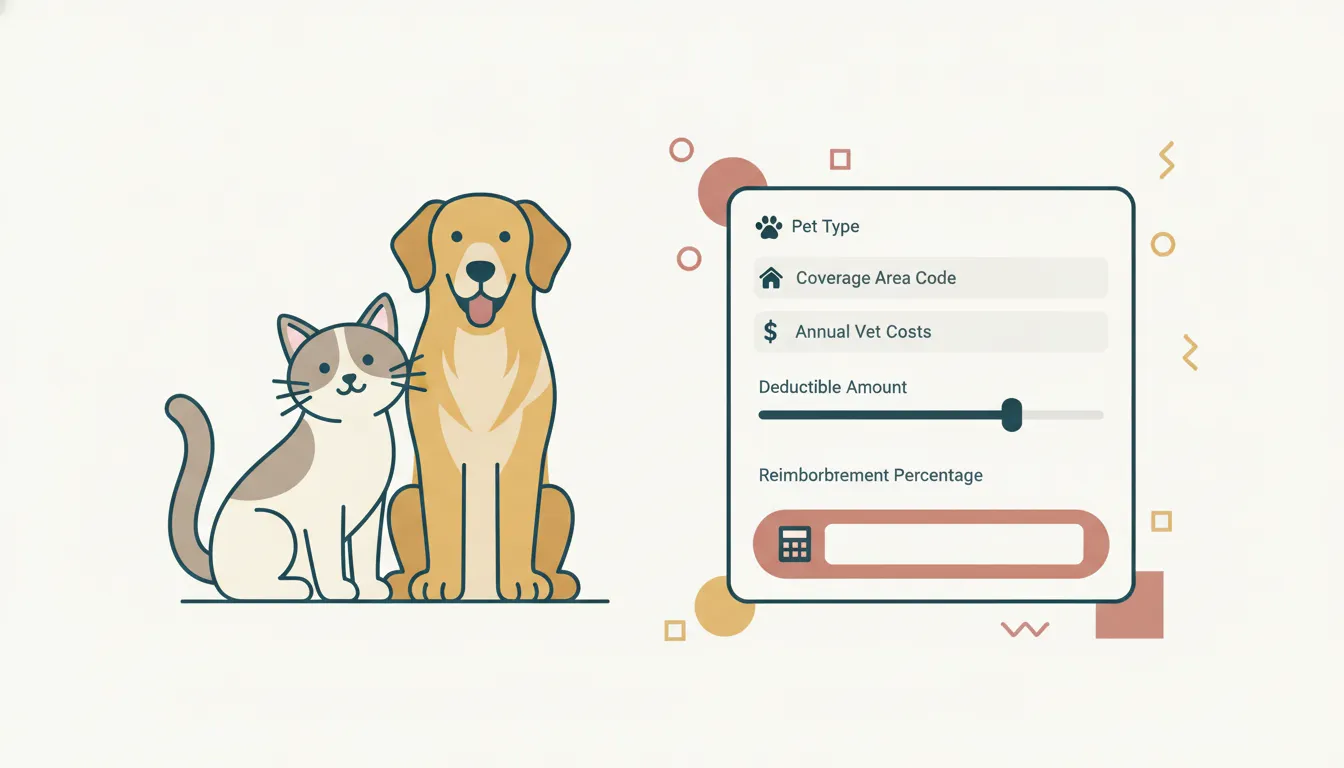
A calculator can show a number in seconds, but it’s only useful if you know what that number represents. A Pet insurance deductible calculator estimates how policy details may affect a claim, often by applying the remaining deductible, reimbursement rate, and annual limit to eligible expenses. That last part matters: not every charge on a veterinary bill may qualify for coverage. Before you enter an amount, check your policy for exclusions, waiting periods, and any limits on treatment. Then use the estimate as a planning tool, not a guarantee. This guide explains what information to gather, how to interpret results, and what to verify before choosing a policy.
Key Takeaways
- Use calculators for planning: Enter the same vet bill and policy details to compare estimated costs across plans.
- Verify coverage before choosing: Check deductible rules, eligible expenses, waiting periods, exclusions, reimbursement rates, and annual limits in the policy documents.
- Compare total costs and get help: Weigh premiums against potential out-of-pocket expenses, request personalized quotes, and ask a licensed broker to explain unclear terms.
What Is a Pet Insurance Deductible Calculator?
A pet insurance deductible calculator estimates how a policy’s deductible, reimbursement rate, and annual limit may affect a claim. It can help you prepare for a vet bill or compare coverage options, but it cannot confirm what an insurer will pay.
Estimate reimbursements and out-of-pocket costs for eligible vet bills
Enter an eligible veterinary expense and your policy details to see an estimated reimbursement and the amount you may pay. If you have not met your deductible, the calculator may subtract the remaining deductible before estimating the insurer’s share. Your costs could also include expenses the policy does not cover.
This estimate can help you plan for a claim, but it depends on how your policy defines eligible expenses. A pet insurance calculator can illustrate the basic calculation. Check your policy for the rules that apply to your pet and treatment.
See how deductibles, reimbursement rates, and annual limits work together
These terms work together to determine a potential payout. For example, say your pet has a $1,000 eligible bill, you have $200 left to meet your deductible, and your reimbursement rate is 80%. A basic estimate subtracts the remaining deductible, then applies 80% to the $800 balance, for an estimated reimbursement of $640, if your annual limit has enough room.
The deductible and the unreimbursed portion of the bill remain your responsibility. If you are close to your annual limit, the insurer may pay less than the estimate. Insurers may also apply these steps differently, so use your policy’s method rather than assuming every calculator follows the same formula.
Treat results as estimates, not coverage guarantees
A calculator’s result is for planning, not a promise that a claim will be paid. The insurer determines reimbursement after reviewing the claim against your policy. Coverage, exclusions, waiting periods, deductible status, annual limits, medical records, and state rules can all affect the final amount.
Before relying on an estimate, confirm that the treatment is covered and that any waiting period has passed. Review your policy documents, or ask a licensed broker to explain how the terms may apply to your pet. If you are comparing plans, use the same bill and coverage assumptions for each estimate, then verify the details before choosing a policy.
What Information Should You Enter?
A pet insurance deductible calculator is only as useful as the information you enter. Gather your pet’s details, policy terms, and an estimate of the vet expenses before you begin. If you’re comparing plans, use the same information for each estimate so you can compare the results fairly.
Pet details: species, breed, age, and ZIP code
Enter whether your pet is a dog or cat, their breed, age, and ZIP code. Insurers may use these details to estimate premiums based on factors such as location and potential health risks. Dogs often cost more to insure than cats, older pets may have higher premiums, and some breeds may be more likely to develop hereditary conditions, as Blake Insurance Group explains.
Use your pet’s actual information rather than an approximate age or breed. For a mixed-breed pet, choose the closest available option or follow the calculator’s guidance. These details help create a more relevant estimate, though insurers may use different methods to set their rates.
Policy details: premium, deductible, reimbursement rate, and annual limit
Check your quote or policy documents for the premium, deductible, reimbursement rate, and annual limit. The premium is the amount you pay for the policy. The deductible is what you pay toward eligible expenses before reimbursement applies. The reimbursement rate sets the insurer’s share of covered costs after the deductible, and the annual limit caps how much the plan pays in a policy year.
Enter each figure as shown in your policy. A higher deductible generally comes with a lower premium, but it can mean more out-of-pocket costs when your pet needs treatment. AARDY’s guide to pet insurance deductibles explains this trade-off.
Claim details: eligible expenses and deductible already met
Enter the estimated vet bill, focusing on expenses your policy may cover. Depending on the plan, eligible costs could include diagnostics, treatment, or medication. Some plans exclude routine care, exam fees, or other charges unless you have coverage for them, so check your policy before adding those expenses to the estimate.
Include how much of your deductible you’ve already paid during the policy period. A calculator may estimate reimbursement by subtracting the remaining deductible from eligible expenses, applying the reimbursement rate, and accounting for the annual limit. The exact calculation varies by policy. For a closer estimate, Blake Insurance Group’s calculator guidance outlines how these amounts can affect a claim. Remember to account for costs the policy does not cover.
Coverage terms: exclusions, waiting periods, add-ons, and claim limits
Check your policy’s exclusions, waiting periods, optional add-ons, and claim limits before relying on a calculator result. A condition may not be covered, or a claim may be ineligible if treatment takes place during a waiting period. Add-ons may cover expenses not included in the base policy, while annual or per-condition limits can restrict reimbursement.
Calculators may not account for every detail, such as policy wording, medical records, state rules, or how a deductible applies across multiple claims. Treat the result as an estimate, not a guarantee of payment. Review the policy documents and ask a licensed broker about terms that could affect your pet’s care. As Blake Insurance Group notes, actual reimbursement depends on the policy and the claim details.
How Do You Calculate Reimbursement and Your Share?
Estimate reimbursement by starting with eligible vet expenses, then applying your deductible, reimbursement rate, and remaining annual limit. Your share may also include excluded charges and any portion of eligible costs the policy does not reimburse. These steps can help you compare possible costs, but the insurer makes the final claim decision based on your policy and records.
Confirm the expense is covered and the waiting period has passed
First, check whether the treatment is covered and whether the applicable waiting period has ended. A policy may exclude certain services or conditions, and routine or preventive care may require separate coverage. Pre-existing-condition rules can also affect eligibility.
Next, separate eligible charges from excluded items. If a $1,000 vet bill includes $800 in covered treatment and $200 in services your policy excludes, use $800 as the starting amount for your estimate. The insurer reviews the claim and applies the policy terms, so a calculator cannot guarantee that a specific expense will qualify. The Blake Insurance Group calculator also notes that actual reimbursement depends on factors such as coverage, waiting periods, and claim review.
Apply the deductible before the reimbursement rate
Once you have the eligible expense total, subtract the deductible amount you still owe. Then multiply the remaining amount by your reimbursement rate. For example, if you have $1,000 in eligible expenses, $250 remaining on your deductible, and an 80% reimbursement rate, the estimated payment is $600: ($1,000 minus $250) multiplied by 80%.
This is a common estimate, not a rule that every insurer applies identically. If you have already met your deductible, there may be no remaining deductible to subtract from a later eligible claim. The Blake Insurance Group calculator’s formula also accounts for the remaining annual limit. Check your policy to confirm how it applies the deductible and reimbursement rate.
Account for copays, annual limits, and uncovered costs
After the deductible, you usually pay the part of eligible expenses your plan does not reimburse. For instance, an 80% reimbursement rate generally leaves you responsible for 20% of eligible costs, often described as your coinsurance. You also pay for expenses that the policy excludes. If the insurer estimates $600 in reimbursement from a $1,000 eligible bill, your share is $400 before adding any excluded charges.
An annual limit can reduce the payment further. If your estimate is $600 but only $500 remains under your policy’s annual maximum, reimbursement may be capped at $500. You would then pay the remaining $500 of the eligible bill, plus excluded costs. Review your annual limit and remaining benefit amount when estimating what you may owe.
Check whether the policy uses an annual or per-condition deductible
An annual deductible applies to eligible claims during a defined policy year. Your payments toward that deductible can add up across claims, and once you meet it, later eligible claims may be reimbursed according to your plan’s terms and limits.
A per-condition deductible may apply separately to each new illness or injury. That means multiple unrelated claims could each have a deductible to meet. The AARDY guide to pet insurance deductibles explains how annual and per-incident deductibles differ. Check your policy wording for the specific deductible type and how the insurer defines a new condition. This detail can make a meaningful difference to your costs when your pet needs care for more than one issue.
Consider deductible resets and how the policy handles multiple claims
An annual deductible typically resets when a new policy year begins. If your pet needs treatment after that reset, you may need to pay toward the deductible again before the plan reimburses eligible expenses. When estimating costs, consider how several claims in one year may share the deductible, as well as what happens when the policy renews.
Some plans use a lifetime per-condition deductible instead. Under this arrangement, a deductible may apply once to a specific condition rather than resetting each year for that condition. Policy terms vary, so confirm how recurring treatment, renewals, and related claims are handled. Business Insider’s Trupanion review describes a lifetime, per-condition deductible. Review your policy documents or ask a licensed broker how the deductible applies to your pet’s likely care needs.
How Can a Pet Insurance Deductible Calculator Help?
A pet insurance deductible calculator lets you test how different policy details may affect what you pay for care. Enter a sample vet bill, deductible, reimbursement rate, and annual limit to see an estimated reimbursement and your possible out-of-pocket share. This can make policy terms easier to understand before you request a quote or choose a plan.
Use the calculator to explore scenarios, not to predict an exact claim payment. The result depends on the calculator’s assumptions and the policy’s terms, including which expenses qualify, when the deductible applies, and whether a limit caps reimbursement. An insurer also reviews each claim according to its policy rules. Check the calculation method and compare it with the policy documents before making a decision.
A calculator is especially useful when you keep your inputs consistent and change one policy feature at a time. That way, you can see how a different deductible or reimbursement rate affects the estimate without confusing the result with other changes. The sections below explain what to test and what to verify.
Test different deductible and reimbursement options
Try a few combinations of deductibles and reimbursement rates to see how they may change your costs. For example, compare a plan with a lower deductible and higher premium against one with a higher deductible and lower premium. Consider both your regular monthly budget and the amount you could pay if your pet needed treatment.
A higher deductible often means paying more before reimbursement begins, while a lower deductible may make claim-time costs more predictable. The trade-off varies by policy, so don’t assume that one option will always be the better value. Review how pet insurance deductibles work, then test the options that fit your budget.
See estimated reimbursements and remaining out-of-pocket costs
A calculator can estimate how much a plan might reimburse for an eligible bill and how much you may have to pay. In a common calculation, the deductible is subtracted from eligible expenses first. The reimbursement rate is then applied, and the annual limit may cap the result.
For example, a $1,000 vet bill may not qualify in full, and the reimbursement may be reduced by your remaining deductible or annual limit. The amount left for you to pay can include the deductible, your share after reimbursement, and expenses the policy does not cover. Use a pet insurance reimbursement calculator to explore the basic math, then check the plan’s terms for claim-specific rules.
Check the calculator’s formula, assumptions, and coverage limits
Before relying on an estimate, check how the calculator handles the deductible, reimbursement rate, and annual limit. Find out whether it assumes the full vet bill is eligible or lets you enter only the portion that may be covered. Also check whether it accounts for a deductible you have already met and any limit remaining for the year.
A calculator may use a simplified formula that does not reflect every policy detail. It might not account for claim limits, multiple claims, or how a policy treats a particular condition. Compare its assumptions with the policy documents, and ask the insurer or a licensed broker to explain any terms that are unclear. That extra check helps you use the estimate as a planning tool, rather than as a guarantee of payment.
Separate eligible expenses from excluded costs
Don’t automatically enter the full veterinary bill as an eligible expense. A policy may exclude certain treatments or conditions, require a waiting period, or cover some services only through an optional add-on. Those costs may remain yours even after you meet the deductible.
Review the policy’s covered services and exclusions before estimating a claim. Pre-existing-condition rules, medical records, state requirements, and the insurer’s claim review can also affect reimbursement. A calculator cannot determine whether a specific diagnosis or treatment will qualify under your plan. Use it to estimate possible costs, then confirm coverage in the policy documents or with a licensed broker.
Use the same inputs to compare policy estimates
For a fair comparison, use the same pet details, sample vet bill, and coverage assumptions for each policy. Keep the deductible, reimbursement rate, annual limit, and estimated eligible expenses consistent wherever possible. Then compare the results alongside each plan’s premium and terms. This makes it easier to see how the policies differ for the same situation.
Check whether each plan uses an annual deductible or a per-condition deductible, since that can affect costs across multiple claims. A calculator can help organize your comparison, but policy documents determine how claims are handled. PIPA Broker can help you review options from multiple carriers and request a no-obligation quote. Ask a licensed broker to clarify differences that may affect your pet’s care and your budget.
How Do Deductibles Affect Premiums and Claims?
Your deductible affects both the premium you pay for coverage and the amount you may owe when your pet needs eligible care. A lower deductible usually means a higher premium, while a higher deductible usually means a lower premium. The best fit depends on your budget, savings, and the policy’s terms. Compare the costs you might face throughout the year, not just the monthly price.
Pay higher premiums for lower deductibles and lower claim-time costs
With a lower deductible, you’ll generally pay less toward eligible vet bills before your insurer starts reimbursing you. The trade-off is usually a higher premium. This option may suit pet parents who want more predictable costs when making a claim or who would struggle to pay a larger bill upfront.
A lower deductible doesn’t mean your insurer will pay the full remaining bill. Your reimbursement rate, annual limit, and exclusions still affect what you receive. Check how each policy calculates reimbursement and which expenses qualify. AARDY’s guide to pet insurance deductibles explains how deductible choices can affect premiums and claim costs.
Choose higher deductibles to lower premiums, but expect higher upfront costs
A higher deductible may lower your premium, but you’ll pay more toward eligible expenses before reimbursement begins. This can work for pet parents who have savings set aside for veterinary care and can manage a larger expense if their pet needs treatment.
Before choosing, consider a bill you could realistically face. If your pet needs care soon after coverage starts, you may have to pay the deductible and your share of the remaining eligible costs. Compare those potential expenses with the premium savings. A lower monthly payment can help your budget, but only if you can afford the deductible when a claim arises.
Compare annual premiums with likely out-of-pocket expenses
Look beyond the premium when comparing plans. Consider the annual cost of coverage alongside the deductible, reimbursement rate, annual limit, and expenses the policy may not cover. A lower-premium plan may leave you paying more when your pet needs care. A higher-premium plan may reduce some claim costs, but it won’t necessarily cover every expense.
Check whether the deductible applies once per policy year or separately to each condition. That difference can affect what you pay if your pet needs treatment for multiple issues. Use consistent assumptions when comparing options. A pet insurance cost calculator can help you model possible costs, but treat its results as estimates and confirm details in the policy.
Choose a deductible you can afford when your pet needs care
Choose a deductible based on what you could comfortably pay out of pocket, not only on the premium you want each month. Think about your emergency savings and how you would manage an unexpected vet bill. If a high deductible could lead you to delay care or take on debt, a lower deductible may be a better fit, even if it costs more in premiums.
Confirm how and when the deductible applies. Some policies use an annual deductible, while others apply one to each condition. Ask how the insurer handles multiple claims and ongoing treatment. These details can make a real difference to your costs, especially if your pet needs care for more than one health issue.
Recheck the trade-off when your premium changes at renewal
When your premium changes at renewal, review the full policy rather than focusing on the new monthly amount alone. Compare the updated premium with your deductible, reimbursement rate, annual limit, and current coverage. If you’re considering another plan, check its waiting periods and rules for pre-existing conditions. A new policy may not cover conditions that developed before coverage began.
You can also request fresh quotes and compare them using the same details about your pet and preferred coverage. Don’t assume that choosing a higher deductible will lower your premium by a specific amount. A licensed broker can help you compare available options and understand how each policy’s terms may affect your costs.
What Deductible Misconceptions Should You Avoid?
A deductible is only one part of your pet insurance costs. How often it applies, what counts toward it, and what the insurer pays afterward depend on your policy. Keep these common misconceptions in mind when estimating claim costs or comparing quotes.
Don’t assume you pay a deductible only once
Some policies use an annual deductible, while others apply a separate deductible to each condition. With an annual deductible, eligible expenses typically count toward one amount during the policy year. It usually resets when the policy renews. With a per-condition deductible, you may pay a separate amount for each covered condition.
The distinction can matter if your pet needs repeated treatment or develops several health issues. For example, Trupanion’s per-condition deductible applies to each condition over the pet’s lifetime, rather than resetting annually. Read the policy details to find out how repeat visits, ongoing conditions, and renewals affect your deductible.
Know the difference between annual and per-condition deductibles
An annual deductible applies to eligible expenses during a policy year. Once you meet it, other eligible claims in that same year may not require another deductible payment. A per-condition deductible applies separately to each new covered illness or injury, so multiple unrelated conditions may mean multiple deductible payments.
These structures can lead to different out-of-pocket costs, especially if your pet needs care for more than one issue. AARDY’s overview of pet insurance deductibles describes annual deductibles as the more common type and notes that per-incident deductibles can add up across claims. Insurers may use different terms, so check your policy wording to understand exactly how your deductible works.
Don’t assume a higher deductible guarantees a specific premium reduction
Choosing a higher deductible may lower your premium, but the amount you save varies. Premiums can depend on your pet’s age, breed, location, coverage, and insurer. Compare personalized quotes using the same coverage details rather than relying on a general estimate of how much a deductible change will save.
Also consider whether you could afford the higher deductible when your pet needs treatment. The lower premium may be a reasonable trade-off for some households, while others may prefer to pay more regularly to reduce costs during a claim. AARDY explains the basic trade-off: a higher deductible can mean a lower premium, but more to pay upfront when you file a claim.
Remember that meeting your deductible doesn’t cover every remaining expense
Meeting your deductible doesn’t mean your insurer will pay the full balance of a vet bill. Your policy may reimburse only a percentage of eligible expenses, up to an annual limit. You’ll also pay for expenses that aren’t covered under the policy, such as excluded treatments or conditions.
For example, with a 70% reimbursement rate, you generally pay the remaining share of eligible costs after the deductible, subject to the plan’s terms and limits. A pet insurance cost calculator can help illustrate how deductibles and reimbursement rates affect a claim estimate. It can’t confirm whether a particular treatment is covered, so check the policy before relying on an estimate.
Use policy terms, not calculator estimates, to determine claim payments
A calculator can help you compare possible costs, but it may simplify how an insurer processes a claim. A tool might subtract the remaining deductible, apply the reimbursement rate, and then account for the annual limit. Your insurer will assess the claim according to the policy’s definitions, exclusions, limits, and claim rules.
Review the policy to learn which expenses count toward the deductible and how the plan handles multiple claims or ongoing conditions. The Blake Insurance Group calculator describes its calculation as a common estimate, not a promise of payment. For a clearer view of your options, compare the policy documents and ask a licensed broker to explain how each plan’s terms could affect your costs.
How Can You Compare Pet Insurance Policies Fairly?
A fair comparison looks at more than the monthly premium. Two quotes can differ because of the deductible, reimbursement rate, annual limit, or the care each plan covers. A lower price may mean higher costs when you file a claim, so consider both the ongoing premium and what you might pay for veterinary care.
Start by using consistent details and coverage settings across quotes. Then review the policy terms, especially if your pet has a health history, takes medication, or may be prone to certain conditions. Quotes and calculators can help you compare estimates, but the policy documents determine coverage. A licensed broker can explain differences between plans and help you identify questions to ask before you choose.
Use the same pet details and coverage assumptions for every quote
For each quote, enter the same pet details, including species, breed, age, and ZIP code. Use the same deductible, reimbursement rate, annual limit, and optional coverage wherever possible. If the settings vary, you may not know whether a price difference comes from the insurer or from the coverage you selected.
Keep a record of each quote’s settings and date. If an insurer doesn’t offer an exact match, compare the closest available options and note what differs. Consistent inputs make estimates easier to compare, as Blake Insurance Group’s pet insurance calculator guidance recommends. Still, matching the numbers doesn’t make the policy terms identical, so check each plan’s details before making a decision.
Compare premiums, deductibles, reimbursement rates, and annual limits
Look at the full cost-sharing arrangement, not just the monthly premium. A deductible is the amount you pay toward eligible expenses before reimbursement begins. The reimbursement rate determines the share the insurer pays after the deductible, subject to the plan’s terms and annual limit. A lower premium may come with a higher deductible, a lower reimbursement rate, or a lower maximum payout.
Check whether the deductible applies annually or separately to each condition, and find out how the insurer calculates reimbursement. These details affect what you may pay when you submit a claim. AARDY’s explanation of pet insurance deductibles outlines how deductible choices can affect premiums and out-of-pocket costs. Compare likely claim costs alongside the monthly price.
Review accident, illness, prescription, and hereditary-condition coverage
Check whether each plan covers accidents, illnesses, prescription medications, and hereditary or congenital conditions. Coverage depends on the policy’s definitions, limits, and exclusions, so don’t rely on a brief list of benefits. If your pet has a breed-related health risk or takes ongoing medication, ask how the plan handles those specific needs.
Separate accident-and-illness coverage from optional wellness or preventive-care benefits. Routine exams, vaccinations, and dental care may require an add-on or may not be covered. Ask whether the policy sets limits on particular treatments, including cancer care or alternative therapies. A veterinary hospital’s overview of common pet insurance coverage can help you prepare questions, but confirm the answers in the insurer’s policy documents.
Check waiting periods, pre-existing-condition rules, exclusions, and claim limits
Find out when coverage begins for accidents and illnesses, since waiting periods may differ. Review how the insurer defines a pre-existing condition and whether a past symptom, diagnosis, or medical record could affect coverage. If your pet has a health history, ask the insurer how those details may apply before enrolling.
Read the exclusions and claim limits closely, too. Look for annual maximums, per-condition limits, restrictions on specific treatments, and services that require an add-on. These terms can affect how much an insurer reimburses, even when a treatment is generally included in the plan. An online estimate won’t show every policy restriction, so check the written terms. Details behind a pet insurance estimate may include waiting periods and exclusions that change what a policy pays.
Verify estimates in policy documents or with a licensed broker
Treat quote and calculator results as estimates, not guarantees of claim payment. Before choosing a plan, review the sample policy, declarations page, and any endorsements or add-ons. Confirm the deductible type, reimbursement method, annual limit, waiting periods, exclusions, and rules for pre-existing conditions. If anything is unclear, ask the insurer to explain the term in writing.
A licensed broker can help you compare available options and explain differences that may be easy to miss, such as how a plan handles a particular condition or claim limit. Share the same pet details and coverage preferences for each comparison, and ask what could change the estimate. You can also request a personalized, no-obligation quote and ask whether a qualifying purchase supports an animal rescue. The policy documents remain the reference for coverage, so verify important details before enrolling.
What Discounts and Extra Costs Should You Check?
A pet insurance premium is only one part of the cost. Compare it with the deductible, reimbursement rate, annual limit, and any optional coverage you may want. Also ask about discounts before comparing quotes, since eligibility and savings can differ by insurer, state, and enrollment method. A discount can make a policy more affordable, but it does not necessarily make it the best fit for your pet or budget.
Check whether routine care, such as vaccinations and wellness exams, is included or offered as a separate add-on. Ask what the add-on costs and how much it pays toward eligible services. As guidance on pet insurance coverage explains, plans can vary, so review the policy details rather than assuming a service is covered.
A personalized, no-obligation quote can help you compare options using your pet’s details and consistent coverage settings. PIPA Broker can match you with insurance options and provide guidance from a licensed broker. If you buy a policy through a broker, ask how the broker is compensated and confirm the policy terms directly with the insurer. You can also check whether a qualifying purchase supports an animal rescue.
Ask about multi-pet, annual-payment, employer, and membership discounts
When you request quotes, ask whether an insurer offers savings for covering multiple pets, paying annually, or enrolling through an employer or membership group. Not every insurer offers all of these discounts, and eligibility may depend on your location or enrollment method. If you insure more than one pet, compare each pet’s premium and coverage separately instead of assuming one discount makes the same plan right for both.
Compare the discounted premium with the deductible, reimbursement rate, and annual limit. A lower price may come with coverage terms that do not suit your needs. Consider what you could afford if your pet needed unexpected care, too. A veterinary hospital’s overview of pet insurance costs discusses how coverage may help with unexpected veterinary expenses, but your own policy terms and budget should guide your choice.
Confirm each discount’s eligibility, duration, and renewal terms
Before counting on a discount, ask who qualifies, when the savings apply, and whether you need to provide proof, such as an employer or membership number. Find out whether it reduces the full premium or only certain coverage. Ask whether it continues at renewal, and what your premium may be when an introductory offer ends.
Check the insurer’s billing or policy documents for the terms, and ask whether you can combine discounts. When comparing carriers, write down both the standard and discounted premiums. This makes it easier to compare the ongoing cost rather than choosing based on a short-term offer. Keep the coverage details consistent, too: a cheaper quote may reflect a different deductible, reimbursement rate, or annual limit. Understanding each price and discount helps you judge whether the policy fits your budget over time.
Check add-on costs and whether preventive care has separate coverage
Ask whether wellness exams, vaccinations, dental cleaning, or parasite prevention are included in the base policy or require an optional add-on. Preventive care coverage may have a separate price, reimbursement rules, or annual cap. Compare the add-on cost with the benefits you expect to use, and check which services qualify before deciding whether it makes sense for your pet.
Also review the costs you may still owe after a claim, including your deductible, copay, and expenses above the policy’s annual limit. Accident-and-illness coverage does not automatically include routine care. Plans differ, so read the policy wording and ask the insurer or broker to clarify any terms you are unsure about. A guide to common pet insurance misconceptions highlights why it is important to check what a specific plan covers instead of relying on general assumptions.
Request a personalized, no-obligation quote and confirm available options
A personalized quote gives you a clearer way to compare prices and coverage for your pet. Provide accurate details, including your pet’s age, breed, and ZIP code. Then check the proposed deductible, reimbursement rate, annual limit, and optional coverage. Ask which discounts are available and whether they are included in the quoted price. When comparing insurers, use the same coverage settings where possible.
Before buying, confirm waiting periods, exclusions, eligible expenses, and how to submit a claim. A calculator can help estimate your share of a vet bill, but its result depends on the inputs and assumptions. For example, a pet insurance reimbursement calculator can show how a deductible, reimbursement rate, and annual limit may affect an estimate. Treat that result as a guide, not a promise of payment. The policy documents determine what the insurer will cover.
Ask whether a qualifying purchase supports an animal rescue
If supporting animal welfare matters to you, ask whether buying a policy through the broker or insurer contributes to an animal rescue. Confirm which organization receives support, what counts as a qualifying purchase, and how the contribution is calculated. Ask when the contribution is made and whether it affects your premium or policy terms.
Look for clear information about the organization and the program’s requirements. If you cannot find those details online, ask the broker directly before choosing a policy. A rescue contribution can be a welcome extra, but it should not take the place of comparing coverage, price, and service. Make sure the policy meets your needs first, then consider any confirmed animal-welfare benefit as part of your decision.
Related Articles
- How Much Does Pet Insurance Cost? Average Pricing in 2025
- How Does Pet Insurance Work? Costs, Claims & Coverage
- Accident Only Pet Insurance: What It Covers
- Pet Insurance Florida: Costs, Coverage, and Exclusions
- Pet Insurance Texas: Costs, Coverage, and Key Risks
Frequently Asked Questions
What does a pet insurance deductible calculator estimate?
It estimates how a vet bill may be divided among your deductible, insurer reimbursement, and out-of-pocket costs. The result depends on the information entered and may not account for every policy rule or excluded expense.
What information do I need to use a calculator?
Gather the estimated eligible vet expenses, your deductible and how much you have already paid toward it, your reimbursement rate, and your annual limit. If you’re comparing plans, use the same bill and coverage assumptions for each estimate.
Does meeting my deductible mean insurance will cover the rest of the bill?
No. You may still owe your share of eligible expenses after reimbursement, costs the policy excludes, and amounts above the annual limit. Check your policy to see how it handles each charge.
Can a calculator tell me whether a treatment is covered?
Not reliably. Coverage can depend on exclusions, waiting periods, pre-existing-condition rules, medical records, and the insurer’s claim review. Confirm the details in your policy or ask a licensed broker about terms you’re unsure of.
How should I choose a deductible?
Compare the premium with the amount you could afford to pay when your pet needs care. A higher deductible may reduce the premium but can mean greater upfront costs. Review whether the deductible applies annually or separately to each condition, and compare personalized quotes using consistent coverage settings.